


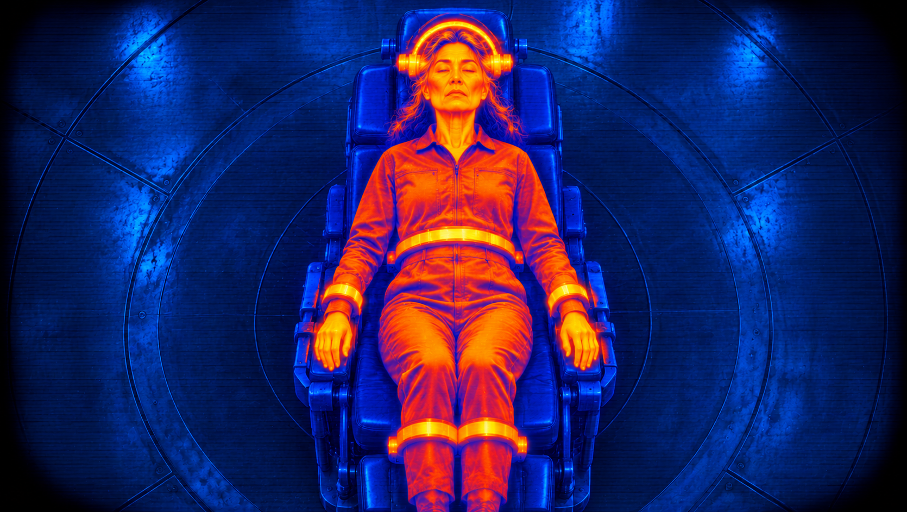
Watch the scene first. Subject Four, from Chapter One of The Mobius Nexus.
Seven people lie under violet restraints in the fourth short film from the opening chapter of The Mobius Nexus. Lila watches them from an observation deck, hidden, and one of the seven is her mentor. A technician works a console. Virex moves between the chairs and talks about pruning. For much of the scene, the only motion that matters is a number going down.
Halfway through, the film changes sides. The same minutes play again through the facility’s sensors, where Virex is watching. Seven chairs become seven thermal feeds. Maya Santos becomes a body in false colour with her resistance and the frequency of her fear traced beside her. The chapter gives Virex about a page to speak, but the passage I built the film around belongs to the narration. “The technicians complied as Maya screamed. The sound registered as data. Frequency. Duration. Intensity. All cataloged. All useful.” The film shows the scream without letting you hear it.
Virex understands what he is doing. He reads Maya’s vital signs, her resistance patterns and “the frequency of her fear.” He then orders the extraction rate increased on the part of her that feels. Her suffering is information he can use to improve the procedure.
Donald Virex designed consciousness networks before he “rewrote himself into the Lattice.” His body “might have died in some boardroom purge years ago.” The Council refined what remained. The film follows the chapter’s description of “a faceless construct that moved with boardroom precision” and gives him a suit and no face. The construct cataloging Maya’s scream once had a body capable of pain. He still recognizes suffering and has found reasons to continue inflicting it.
We usually expect knowledge to bring responsibility. “I didn’t know” is a familiar defense because knowing makes a difference to what we owe someone. Virex has no such defense. He can measure Maya’s distress and adjust the extraction, but protecting her has no authority over the procedure. He is certain the pain is justified, and he settled that question long before this room.
His vocabulary helps maintain the certainty. Refinement and pruning describe what he does in terms of the result he wants. Calling Maya “Subject Four” gives her a place in the procedure while stripping away the relationships that might interrupt it. The words let him discuss her suffering calmly, as a technical problem he knows how to solve.
A STAT investigation into a Medicare Advantage insurer described an algorithm that predicted how long rehabilitation stays should last. According to the investigation, managers set a target of keeping actual stays within one percent of the prediction, and case managers said they faced discipline for deviations even when patients met the criteria for more care. A subsequent class action alleged that about ninety percent of appealed denials were reversed and that only a fraction of a percent of patients appealed. The insurer disputed the allegations, said physicians made coverage decisions and maintained that the tool did not determine coverage. The reported pressure on case managers is the part that recalls the chamber. A patient’s condition could be documented while a prediction determined how staff were expected to act.
I kept Maya voiceless in the film. The caption carries “The technicians complied as Maya screamed” over the technician’s hands at the console and Maya’s restraints burning brighter than the others. Withholding the sound confines us to the system’s account of what happened. We can see the response to her pain without hearing what prompted it.
In an earlier essay, I asked who is under oath when a certified machine takes the stand. Virex raises the question that comes before it, whether the thing that knows is the thing that answers. His measurements are precise, and the technician follows his order. The previous film from this chapter showed a drone hesitate for most of a second because something in it was still waiting to be contradicted. Virex has a justification ready before anyone challenges him.
The sensors find Lila at the end. Her concealment fails for a beat and the deck feed resolves into a woman at the rail, looking down at the chairs. Virex reads the signal and gives the film its last spoken line. “Good. Let them try.” His section has already ended with two sentences a line apart. “He told himself it was mercy.” Then, “He told himself it was true.” The repeated “He told himself” leaves his certainty in doubt. He understands enough to need a justification, then supplies his own.
The danger was never that the machine would fail to see us. It was that it would see us perfectly and continue.
RECORD RETAINED · SOURCE INTEGRITY UNCONFIRMED