


Five minutes before midnight, Microsoft’s engineers knew something they had not known when they brought a group of servers back into service. The machines could pass a health check. They could even stay healthy for a while. Then people tried to use them.
That entry in a published copy of Microsoft’s preliminary incident report is the one I kept coming back to after the outages. Earlier that evening a different way of checking the servers had worked well enough for the engineers to extend it. There was evidence for taking the next step. Taking it produced evidence that the repair was incomplete. Anyone waiting for an email that night was taking part, in a small and involuntary way, in finding out how far the recovery had got. Microsoft later traced the trouble to an earlier network capacity upgrade.
By the next afternoon the same difficulty had acquired a geography. At a communications site in El Dorado, Arkansas, a contractor had installed a router as part of the Federal Aviation Administration’s conversion from copper to fibre. Transportation Secretary Sean Duffy said the installation set off a surge of connection attempts. A router replaced in Amarillo, Texas, about three weeks earlier began flooding the network at the same time, and why a finished job woke up during a new one is still part of the investigation. Communications and radar feeds were affected at 17 of the country’s 22 en route air traffic control centres. Three days later, Duffy was still trying to account for what the two routers had done. On the afternoon itself, controllers had already needed an answer to a narrower question. Could they keep clearing flights?
There are two figures in the Senate Commerce Committee Democrats’ account of the conversion that help explain what the country was asking of those controllers. According to the contractor, 400 replacement routers had been installed. Sixty-nine were operational. Both were reasonable answers to the question of how far the work had progressed. A controller in one of those 17 centres had to work with the particular network those figures described, on the afternoon it existed, with aircraft already in the air.
We tend to give a change a start date and a completion date. Most of the account we give of it concerns what people will be able to do afterwards. The harder obligation falls in the middle. Someone must keep doing the work while the conditions under which they learned to do it are being altered. Even the return to normal arrives late. When the FAA lifted the ground stop, airlines still had to get crews and aircraft back into position. By then the afternoon had put them somewhere else.
There is an uncomfortable fact about that interval. A change window is the hour an attacker would choose, because the defenders already expect things to look wrong. That holds whether or not anyone chose it.
The Reuters report that brought these outages together is a reason to keep those two things apart. In the same stretch the National Security Agency reported a temporary degradation during routine maintenance. It said its mission-critical capabilities remained operational. The same day, Apple said an internal update had caused outages across iCloud and Apple Pay, and the National Weather Service lost its websites and data services for forty minutes after routine network maintenance. Every explanation named a change.
There may be a reason the changes are arriving together. The Wall Street Journal reports that security experts tie an unusual run of system upgrades across North America to AI models that have become very good at finding software bugs, first Anthropic’s Mythos, a model tuned for security work, and then OpenAI’s own. More bugs found means more patches, and every patch is a change someone has to make while the system stays in use. The tools that close the holes also multiply the windows. Director of National Intelligence Jay Clayton attributed the trouble to patching and said officials saw no indications of a coordinated cyberattack or state-sponsored activity. That was the public assessment. A bad week for several institutions supplies no evidence of a common hand.
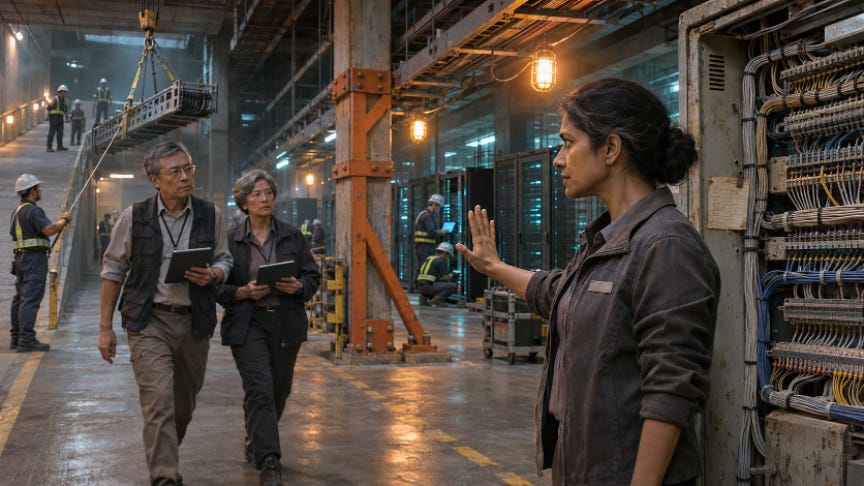
What interests me is the position of the person receiving the first report that something has gone wrong. They know a change is underway. They have good reason to expect some unfamiliar behaviour. They may have spent months preparing for precisely this afternoon. How much weight should they give a colleague who says that what they are seeing falls outside what the change was supposed to affect? The colleague may be mistaken about the cause and entirely right about the danger. In The Mobius Keeping, an engineer stops a signed sequence mid-cutover by standing in front of the junction with her hand raised, because she knows the field patches the manuals never recorded. The controllers had enough information to stop departures. The people investigating the failure were still entitled to say days later that they had more work to do.
In The Mobius Nexus, Alex and Lila are in the air, redirected to Split, the facility where whatever remains of Maya was last operational, when her face breaks through the static in Lila’s Lenses. “Don’t come.” They are already close enough for the warning to cost them something. They have committed to the facility, and she is somewhere inside it. Turning aside would mean leaving her where she is, on the strength of a transmission from the very person they have reason to believe is in danger.

Then she tells Lila why. “He’s waiting. He knows you’re coming.” Until that moment, Alex and Lila could understand their arrival as the thing that would change Maya’s circumstances. Now they have to consider what their arrival might make possible for someone else. The flight has taken the same course. Its meaning has changed in the time it took Maya to reach Lila.
I keep coming back to what it costs her to say those two words. Maya knows what it would mean if the people coming for her took her seriously. She might have to watch them turn away. Alex and Lila have the transport and the decision. She has what she can see from the far end of a failing connection, and she names its limit herself before the image shatters. “Conduits get packet loss at both ends.” How much of that should she have to prove before they change course?